An unexamined life is not worth living.

Saturday, June 6, 2009

Peshk@ – new chess training software from developers of Chess Assistant

I just downloaded this neat tool from http://chessok.com/?p=22212 and after playing with it for a few minutes – I must say it looks pretty neat. The interface shell itself is free, it comes with a few demo courses and you can download more for extra charge. This follows a model similar to what Chessbase is doing with ChessBase Light as a viewer for their media lessons, where the viewer is free, but you have to pay for extra courses. Here are a few screenshots of the demo endgame course I downloaded off their website also for free (based on a book by Alexander Panchenko, who sadly recently passed away). Even without buying anything – there is a fair bit of interesting content for you to look at, before deciding which course is most worth your hard earned $25.

Training mode:

image

Theory mode:

image

The course browser, as you can see – I got the demo one:

image

From what I understand, this is to replace all the old training software that Convekta had, where you had to install a separate shell for every course, which was obviously more clunky, and probably harder to sell.

Thursday, June 4, 2009

Paul Keres Memorial 2002 – part 3 - combinations

To conclude posting extracts from my 7 year old En Passant article about this tournament, here are a few tactical positions:

(6) Leblanc,Paul - Spears,Nicholas [D02]
Keres mem 27th Vancouver (2.10), 18.05.2002

image Black to move

16...Rh1+ 0-1

(7) Wu,Howard - Daswani,Ben [C09]
Keres mem 27th Vancouver (4.21), 19.05.2002

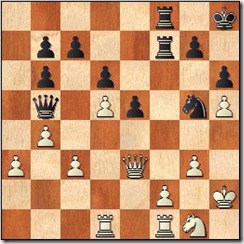
image White to move

White is completely winning, but the finishing move is neat. 17.Qh5! 1-0

(8) Lee,Mau-Seng - Stanford,Mike [B45]
Keres mem 27th Vancouver (5.7), 19.05.2002

White played 25.Bd2 overlooking a queen sacrifice:
keres2002_181Black to move
25...Qxh2+ 0-1

Wednesday, June 3, 2009

Opposite Coloured Bishops – Part 5

Continued from Part 4

(7) Kotov Alexander (RUS) - Botvinnik Mikhail (RUS)
Ch URS Moscow (Russia), 1955

image

25...Be4! Black's advantage is obvious: his bishop is much better than White's. 26.Qd2 Qg4 Black exerts pressure on 'g2'; his own pawns on f6 and g7 make similar ideas by White impossible. 27.h3 Qg6 28.Qf2 h5 29.Kh2 a5 Diagram

opposite_bishop_98

In these positions, it is important for the stronger side to have its pawns on the squares of the colour same as the opponent's bishop to limit its scope. 30.Ba3 b5 31.Bc5 b4 32.Rcc1 Rdc8 33.Bd4 Bc2 34.Rd2 Be4 35.Rdd1 Qf5 36.Qe2 Qg6 37.Qf2 a4 ! ? 38.Rxc8+ Rxc8 39.bxa4 Qe8 40.Rd2 Qxa4 41.Qh4 Rc2 Of course, trading rooks relieves White's defensive task, but there was no other way to win the 'a2' pawn. 42.Rxc2 Qxc2 43.Qg3 Qxa2 44.Bxf6 Qxg2+ ! 45.Qxg2 Bxg2 46.Bd4 Be4 Black won a pawn, but the position is very likely drawn. With great ingenuity Botvinnik confuses his opponent and pulls out a study-like win. 47.Kg3 Kf7 48.h4 g6 49.Kf2 Ke6 50.Ke2 Kf5 51.Kd2 Kg4 52.Bf6 White is defending according to the general principle: the king should block the passed pawn, while the bishop is defending his own pawns on the other flank. But he has to be very careful as both 'h4' and 'e3' require protection, and the 'b' pawn can be used to deflect one of defenders. 52...Kg3 53.Be7 Kh3 54.Bf6 Kg4 55.Be7 Bf5! Diagram

opposite_bishop_99

The bishop is being transferred to 'e6'. Notice that in the middlegame it would have been a passive square for it, but in the endgame the bishop is going to be very useful on the 'a2-g8' diagonal. 56.Bf6 Kf3 57.Be7 b3 58.Kc3 Be6 59.Bc5? Diagram

opposite_bishop_100

[59.Kxb3 d4+ 60.Kc2 dxe3 61.Kd1 Kf2 62.Bc5 Bb3+ 63.Kc1 Kf3 64.Kb2 Bd1 65.Kc1 Ba4 66.Bd6 Kg4 67.Be7 Kxf4-+; 59.Kd2 ! 59...b2 60.Kc2 Kxe3 61.Kxb2 Kxf4 62.Kc3= is given by Botvinnik] 59...g5 !! Shock. 60.fxg5 [60.hxg5 h4 61.f5 Bxf5 62.Kxb3 h3 63.Bd6 Kxe3] 60...d4+ ! The 'b' pawn must be saved. Material balance does not matter much as Black gets two distant passers, 'b' and 'h' pawns. White gets two passers too, but the bishop on e6 is acting according to the principle of one diagonal! It stops both White pawns and defends his own 'b3 pawn', along the a2-g8 diagonal. If White's pawn was on a4 instead of d4, he would not lose. 61.exd4 Kg3 that's why Black played 'g6-g5' - now the 'h4' pawn cannot be protected by the bishop from e7. 62.Ba3 Kxh4 63.Kd3 Kxg5 64.Ke4 h4 65.Kf3 Bd5+ Kf2 Kf4 and the king marches to c2. 0-1

Monday, June 1, 2009

Paul Keres Memorial 2002 – Part 2 – two bishops in the endgame

Part 1. I did not perform too well in that edition of the Keres Memorial, but the first round win was very satisfying:

(5) Jiganchine,Roman - Maheux,Pierre [B32]
Keres mem 27th Vancouver (1.9), 17.05.2002

1.e4 c5 2.Nf3 Nc6 3.d4 cxd4 4.Nxd4 e5 5.Nb5 a6 6.Nd6+ Bxd6 7.Qxd6 Qf6 Starting a new opening is always a painful process, so I felt myself really uncomfortable about the fact that in this position I was already out of book. 8.Qxf6 [Theoretical 8.Qd1 Qg6 seemed to involve some subtleties so I decided to go for a simple solution, even though it Black might get good chances to equalize immediately.] 8...Nxf6 9.Nc3 d5 10.exd5 Nb4 11.Bd3 Nfxd5 12.Nxd5 Nxd5 13.Bd2 Diagram

keres2002_174

And here I got really happy about my two bishops. In this pawn structure the control of the 'd' file is what each player strives for to get an advantage, but for now it is blocked by 3 minor pieces, and I decided that my chance is instead to put pressure on the e5 pawn.13...Be6 14.0-0 [14.0-0-0!?] 14...0-0-0 15.Ba5 Rde8 [15...Rd7!] 16.Rfe1 f6 17.g3 Diagram

keres2002_175

preventing ...Nf4. Depriving opponent's knight of outposts is a common strategy when possessing two bishops.17...Ne7 18.c3 Kb8 19.Bb6 Nc8 20.Be3 Rd8 21.Bf1 Bd5 22.f4 Diagram

keres2002_176

Hoping to open up the position for the bishops22...exf4? Black cooperates... 23.Bxf4+ Ka8 24.c4 Bc6 25.b4 Now White has a large advantage: I managed to get my pawns advance, and Black's pieces are pushed back to the last ranks. 25...Rhe8 26.b5 axb5 27.cxb5 Be4 28.Bc7 Diagram

keres2002_177

With a very tempting idea to set up a mating net: now White just has to get a rook on the 'a' file. 28...Rd4 29.Rad1 Rxd1 30.Rxd1 Re7 31.b6 Bc6 The threat was 32. Rd8 Bf5 33.Rd5 and Ra5. 32.Bh3 Re8 33.Rd3 Bb5 34.Ra3+ Ba6 Diagram

keres2002_178

35.Rxa6+ I was really pleased that the game ended with this mini-combination: the advantage of two bishops was converted in its pure form: [35.Rxa6+ bxa6 36.Bg2+ White uses only his bishops to deliver mate.] 1-0
You can replay this game in a viewer:

Sunday, May 31, 2009

Paul Keres Memorial 2002 – part 1 – 3 wins by Bobby Meng

In 2002 Keres memorial - Bobby Meng was provided a sensation result, tying for first place with Georgi Orlov and Jack Yoos among others, beating the new Canadian Champion Pascal Charbonneau in the process. I wrote a report about the tournament for En Passant, so here is the selection of Bobby`s games. I analysed 3 games in that article:
Meng-Wu
Pupols – Meng
Adam - Meng

(1) Meng,Fanhao - Wu,Howard [D42]
Keres mem 27th Vancouver (1.10), 17.05.2002

1.e4 c5 2.c3 Bobby is a loyal supporter of this move and it does bring him good results. 2...Nf6 3.e5 Nd5 4.d4 cxd4 5.cxd4 Nc6 6.Nf3 d6 7.exd6 e6 8.Nc3 Bxd6 9.Bd3 0-0 10.0-0 Diagram

keres2002_154

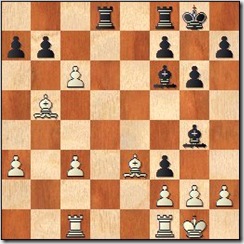
10...Be7 [10...Nce7!?] 11.a3 [I prefer 11.Re1 , but Bobby usually goes for queenside play in these IQP positions] 11...Bf6 suddenly the game transposed into the major theoretical QGD line. White is doing well in this line, so I don't think Black's two move manoeuvre Bd6-e7-f6 was really worth the time investment 12.Be3 [Again, Bobby ignores main lines: 12.Be4 scores well for White] 12...g6 13.Rc1 Nxc3 14.bxc3 e5 [14...b6 15.Bh6 Bg7 16.Bg5 Qc7 17.c4 Bb7 18.d5 Ne5 19.Be4 Qd6 was Gelfand-Van Wely, 1998. The position soon simplified to a draw: 20.Bf4 exd5 21.Bxd5 Bxd5 22.Bxe5 Bxe5 23.Nxe5 Qxe5 24.Qxd5 Qxd5 25.cxd5 Rfd8 26.Rfd1 Rac8=] 15.Bb5 Bg4 16.d5 e4? a miscalculation [>=16...Ne7+/=] 17.dxc6 exf3 18.Qxd8 Raxd8 Diagram
keres2002_155

19.Bc5? Now Black is doing ok again [19.cxb7!+-] 19...fxg2 20.Kxg2 bxc6 21.Bxf8 [21.Bxc6!? Rd3 22.Bxf8 (22.f3 Rc8 23.Be4 Rxc3 24.Rxc3 Bxc3 25.fxg4 Rxc5 26.Rc1 Bd4=) 22...Bh3+ 23.Kg1 Bxf1 24.Bc5! Bh3 25.Bxa7 Bxc3 26.Be4 Rd7 and Black is ok] 21...cxb5 22.Bc5 Rd3?! [>=22...a6] 23.f3 Be6 24.Rfd1 Rxd1 25.Rxd1 Bxc3 26.Rd8+ Kg7 27.Bxa7 Bb2?! [27...b4!? 28.axb4 Bxb4 29.Bd4+ Kh6; 27...Kf6] 28.Bd4+! Bxd4 29.Rxd4 Diagram

keres2002_156

and White managed to win this endgame29...Kf6 30.Kf2 Ke5 31.Ke3 Bb3 32.Rd7 Ke6 33.Rb7 Bc4 34.Kd4 g5 35.Kc5 h5 36.Kd4 [36.Rxb5 Bxb5 37.Kxb5 is not more than a draw for White 37...Kd6 38.Kb6 g4 39.fxg4 hxg4 40.a4 f5] 36...f6 37.Rc7? [37.a4 Be2 38.Ke3 Bc4 39.axb5 was winning on a spot] 37...Kf5 38.Ke3 Kg6 39.Rc5 Kh6 40.Ke4 Kg6 Diagram

keres2002_157

41.h4 [Bobby's calculation (or intuition?) is precise: 41.Rxc4 here (and earlier) does not win: 41...bxc4 42.a4 f5+ 43.Kd4 g4 44.fxg4 fxg4 45.a5 h4 46.a6 g3 47.hxg3 hxg3 and Black queens with check] 41...gxh4 [41...Be2 42.hxg5 fxg5 43.Rc6+ Kg7 44.Kf5 Bxf3] 42.f4 h3 43.Kf3 Bf1 44.Kg3 Be2(.) [44...Kh6 45.Kh4 h2 46.Rxh5+ Kg6 47.f5+! Kf7 48.Kg3] 45.Kxh3 Kf7 46.Kh4 Ke6 47.Rc2 Bd3 48.Rc3 Bf1 49.Kxh5 Kf5 50.Rc2 Bd3 51.Rf2 Ke4 52.Kg4 f5+ [52...Ke3 53.Rf3+ Ke4 54.Rh3] 53.Kg5 Ke3 54.Rb2 Ke4 55.Rb4+ Kd5 56.Kf6 Kc6 57.Ke5 Kc5 58.Rd4 Bb1 59.Rd5+ Kc4 60.Ke6 Bd3 61.Rxd3 1-0

(2) Pupols,Viktors - Meng,Fanhao [D12]
Keres mem 27th Vancouver (5.5), 19.05.2002

keres2002_158

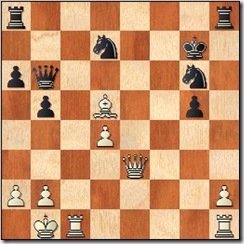
27...Kf7 In this game Bobby got lucky: having been outplayed, he is now receiving a couple of strong blows: [27...Kd8!?] 28.g5 fxg5 29.Nxd5!? exd5 30.Bxd5+ Kg7 Diagram
keres2002_159

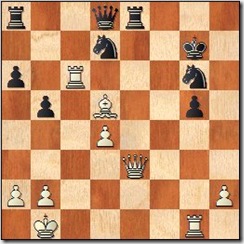
31.Rc6!? [31.Bxa8] 31...Qd8 32.Rg1 Re8 Diagram
keres2002_160

33.Qc1? A strange decision, having conducted the attack with great energy White suddenly retreats. [Winning was 33.Qf3! Rf8 34.Qh5 Rf6 35.Rxf6 Nxf6 36.Qxg5 Nxd5 37.Qxg6+ Kf8 38.Rf1++-] 33...Rc8 34.Rxg5 Ndf8 35.Rxc8 Qxc8 36.Qxc8 Rxc8 37.Bb7 Rd8 38.Rg4 Rd6 Diagram

keres2002_161

Black consolidated and went on to win this endgame with an extra piece. 0-1

(3) Adam,Valerian - Meng,Fanhao [C50]
Keres mem 27th Vancouver (3.4), 18.05.2002

1.e4 e5 2.Nf3 Nc6 3.Bc4 Bc5 4.0-0 Nf6 5.d3 d6 6.Be3 Bb6 7.h3 0-0 8.Nc3 Be6 9.Bxb6 axb6 10.Bxe6 fxe6 11.d4 Nd7 12.d5 exd5 13.Nxd5 Nc5 Diagram

keres2002_162

I think this is Bobby's best game in the tournament: he manages to play around the White knight on d5 and his own knights start an impressive tango: the semi-open 'f' file, and the h2-h3 advance provide Black with good chances on the kingside.14.c3 Kh8 15.Qe2 Ne7 16.a3 Ng6 17.g3 White covered both d4 and f4, but now the Nf3 lacks support 17...Ne6 18.Qe3 h6 Bobby makes sure that White can never play Ng5, trading off a badly placed N 19.Rad1 Qd7 20.Kh2 Rf7 21.h4 Qb5 Diagram
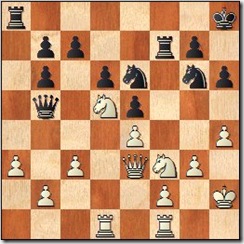
keres2002_163

playing on both flanks reveals a rather mature positional player22.h5 Raf8!? [22...Ne7?! 23.Nxe7 Rxe7 24.Nh4 would have allowed the White N to get to better squares, now he has to go down..] 23.Ng1?! [23.Nd2!?] 23...Ne7 24.b4 Nxd5 25.exd5 Diagram

keres2002_164

25...Ng5

keres2002_165

Very nice! Black traded off White's strong Nd5, and White is now left out with a passive Ng1 26.f3 Qd7 27.Kg2 Rf6! 28.Qe2 Qf7 29.g4 Rf4 30.c4 Qd7 31.Rde1 Kg8 32.Kg3 Kh8 33.Kg2 e4! Diagram

keres2002_166

Now White's pawn structure collapses34.fxe4 Qxg4+ [34...Rxg4+ 35.Kh2 Rxf1 36.Rxf1 Rxe4 was probably an easier way to win - perhaps a bit typical for Bobby: if he sees a good continuation, he sometimes does not stop to look for anything better] 35.Qxg4 Rxg4+ 36.Kh2 Rxf1 37.Rxf1 Rxe4 38.Rf8+ Kh7 39.c5 bxc5 40.bxc5 dxc5 41.Rc8 Re7 42.Kg2 g6 43.hxg6+ Kxg6 Diagram

keres2002_167

and having centralized his K, Black won without any difficulties 0-1

Saturday, May 30, 2009

Opposite Coloured Bishops – part 4

Continued from Part 3. The following positions have rooks on the board in the beginning.

(6) Berry Jonathan (2272) - Yoos Jack (2371)
2000 B.C. championship (6), 23.04.2000

opposite_bishop_95

With rooks it is often hard to give a definitive evaluation of a position, one can just talk about winning or drawing chances. But it is very important to correctly evaluate the simplified pure ending with bishops of opposite colours, in order to make a right decision at the critical moment. 42...Bc6 White's up two pawns, so he is probably winning. 43.Bd8! Bxe4 44.Bxc7 Bc6 45.g5!? Diagram

opposite_bishop_96

White intends to play Bc7-d8-f6, and Rh4. Black's response seems to be forced... 45...f5 But is it? ? [45...Re1+!? 46.Kh2 Re2! 47.Rg4 Kf8 was certainly better. White is tied up to defence of g2, and Black can has good drawing chances.] 46.gxf6+ Kxf6 47.Rf4+ Kg7 48.Bb6 Re2 49.Rf2 ! note that White did not have this option if Black activated the rook on move 45. Also now that the double g5 pawn is traded off, the endgame without rooks is easier to win for White. 49...Re1+ both players correctly evaluated the position without rooks as winning for White. 50.Kh2 Be4 51.Bd4+ Kg8 52.Kg3 Bd3 53.Kh4 Re7 54.Kg5 Rf7 Otherwise Rf2-f6xg6 was going to be unpleasant. 55.Rxf7 Kxf7 56.g4 Diagram

opposite_bishop_97

56...Bc2 57.h4 Bd3 58.h5 gxh5 59.gxh5 Ke6 60.h6 Bh7 61.c4 Bd3 [61...Kf7 62.b5 Bd3 (62...Kg8 63.c5 Be4 64.c6) 63.c5 Kg8 64.c6+-] 62.c5 Kf7 Black seems to have blocked everything, but White has prepared a breakthrough. [62...Be4 63.b5] 63.b5 ! 63...axb5 [63...Be4 64.c6] 64.c6 ! 64...bxc6 65.a6 c5 66.a7 [Be4 66.h7 ] 1-0

Opposite Coloured Bishops – part 3

Continuing from part 2, Let's look at some typical ideas:
1) The strength of connected pawns
2) Distant passed pawns
3) Pawn weaknesses
4) Active king
5) Rule of one diagonal
(5) Smyslov Vassily (RUS) - Stein Leonid (UKR)
Ch URS Moscow (Russia), 1969

opposite_bishop_92

37.Bd4 ! Now White effectively has two extra pawns on the kingside. 37...a6 38.Kf4 Ke6 39.Kg5 Kf7 40.Kf4 Ke6 41.Bb6 Bb3 42.g4 hxg4 Diagram

opposite_bishop_93

43.Kxg4 ! 43...Bd1 44.Kf4 Kf7 45.Bd4 Kf8 46.Ke3 Kf7 47.Be5 Ke6 48.Bg3 Kf6 Black makes things harder for White by attacking the f3 pawn. 49.Bf4 Ke6 Diagram

opposite_bishop_94

50.h5!! gxh5 51.Bg3 White's plan now is very simple: f3-f4-f5, Kf4, Bh4, etc. Despite even material Black is helpless against the advance of the White pawns; sacrificing the bishop (as in theoretical position #3) would not work of course, as White has queenside pawns left. 1-0

Hit Counter