Topalov, V. -- Grischuk, A.
2nd Norway Chess 2014 2014.06.04 0-1 B90
1. Nf3 c5 2. e4 d6 3. d4 cxd4 4. Nxd4 Nf6 5. Nc3 a6 6. Be3 Ng4 7. Bc1 Nf6 8. h3 e5 9. Nb3 Be6 10. Be3 Be7 11. f4 exf4 12. Bxf4 Nc6 13. Qe2 Nd7 14. O-O-O Nce5 15. Nd5 Bxd5 16. Rxd5 O-O 17. Kb1 Qc7 18. Rd1 Nb6 19. h4 Nec4 20. Rh3 Bf6 21. c3 Rfe8 22. Nd4 Qc5 23. Nf5 d5 24. e5 Bxe5 25. Qg4 g6 26. h5 Qf2 27. Nh6+ Kg7 28. Bc1 f5 29. Qf3 Qxf3 30. Rxf3 Rad8 31. g4 d4 32. hxg6 hxg6 33. Rfd3 Nd5 34. cxd4 Bf4 35. Bxf4 Nxf4 36. Rf3
Showing posts with label Players - Topalov. Show all posts
Showing posts with label Players - Topalov. Show all posts
Sunday, August 3, 2014


Sunday, October 20, 2013
Topalov Defeats Anand - Bishops of Opposite Color Endgame
This game in the video is taken from my E-book about endgames with bishops of opposite color.
http://www.amazon.com/Bishop-Endgames...
The book is formatted for electronic readers and can be read on devices of various sizes, from tablets to phones. The free sample includes 3 thoroughly annotated games and the full book comes with dozens of training positions to help develop a good sense for positions with bishops of opposite colour.
This bishop endgame is a good illustration of thinking in schemes. Black had to keep track of the functions of each of his pieces - in the final position the king had to block the pawn 'd', and the bishop - defend the 'h7' pawn. Because they reversed the roles after Anand's mistake, White had an option of breaking through to the 'd' pawn and winning a piece.
http://www.amazon.com/Bishop-Endgames...
The book is formatted for electronic readers and can be read on devices of various sizes, from tablets to phones. The free sample includes 3 thoroughly annotated games and the full book comes with dozens of training positions to help develop a good sense for positions with bishops of opposite colour.
This bishop endgame is a good illustration of thinking in schemes. Black had to keep track of the functions of each of his pieces - in the final position the king had to block the pawn 'd', and the bishop - defend the 'h7' pawn. Because they reversed the roles after Anand's mistake, White had an option of breaking through to the 'd' pawn and winning a piece.
Saturday, August 28, 2010
Opposite Coloured Bishops – part 16 - Conclusion
This is the last post on the subject of endgames with bishops of opposite colours – all examples are from my article on the same subject published in Canadian chess magazine “En Passant” almost 10 years ago.
There is an attitude to endings with opposite coloured bishops that 'they are all drawn'. There is certainly a good reason for this. And yet almost all examples that I showed had a decisive result. Partly this is because in most of them one side had a material advantage. But some endings shown had even material in the starting position. Therefore, in a position with rooks on the board, it is often possible to outplay your opponent. If you are playing for a win, there might also exist a psychological effect that would help you: when seeing opposite coloured bishops, even strong players may relax and expect that even with second rate moves they will get their draw. Not necessarily!
I also hope that the readers’ thinking about types of endings will expand from "pawn endings" and "rook endings" to more complex combinations of material, such as “rooks + bishops of opposite colour”, “rooks + knights”. These are what Dvoretsky calls “simple positions” – not quite endgames, but nor middlegames either. Studying ideas typical for each type of these simple positions will lead to a better understanding of chess.
To wrap up the series, here is the analysis/solution for the puzzle from the last post.
Topalov Veselin - Shirov Alexei, Linares (10), 1998
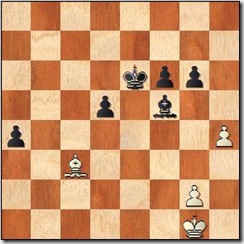 Black to move

47...Bh3 !! An amazing move, which initially does not seem to make any sense. The point is that Black's king needs to support the 'd' and 'a' pawns as soon as possible. The bishop on e4 was on his way. By going to h3, Black attacks the 'g2' pawn, so he wins a tempo. The reason why he is not afraid to lose the bishop, is because this bishop would not help him to advance the queenside pawns anyways. 48.gxh3 Kf5 49.Kf2 Ke4 50.Bxf6 d4 Diagram

51.Be7 Kd3 52.Bc5 Kc4 53.Be7 Kb3 Diagram

The Black king comes to c2. 0-1
Thursday, August 26, 2010
Opposite Coloured Bishops – part 15
I am now wrapping up the series on endgames with opposite coloured bishops, with a couple of positions for you to solve. Topalov Veselin - Shirov Alexei, Linares 1998
Spraggett Kevin - Hartman Brian, Hamilton m (4), 1993

For the solution and to see the whole game go to http://www.chessgames.com/perl/chessgame?gid=1131765
Hint: One of the characteristics of endgames with opposite coloured bishops and rooks, is that when the weaker side tries to setup the blockade, the stronger side’s rook can be sacrificed for the blockading bishop.
Topalov Veselin - Shirov Alexei, Linares 1998
 Black to move

The next post will include the full solution to this famous position, but if you can’t wait – the game is available here: http://www.chessgames.com/perl/chessgame?gid=1143956
Thursday, June 17, 2010
Ivanchuk – Topalov, a brilliant attacking game
I continue to study the typical middlegame positions by making YouTube videos with grandmaster games.
Today it is Ivanchuk – Topalov, 1996.
Here are few key moments:


The game makes a great impression, given how White sacrifices the pawns to open up the diagonals for his bishops. Here are more observations about this middlegame structure:
- White can control the ‘a’ file effectively after black plays b7-b5
- b2-b4 normally weakens a lot of squares along the ‘c’ file in the Open Sicilian, but when White has control over the center – can be effective at preventing b5-b4, Nd7-c5, and leaves Black’s ‘b’ pawn a good target.
- f7 pawn is also a good target if the Black rook is on e8 and the Black knight leaves e5 square
- If you play against Vassily Ivanchuk, and you attack his rook on the queenside, he is probably going to move a pawn on the kingside…
You can also replay through the game in the pgn viewer at chessgames.com.
Wednesday, May 5, 2010
Anand – Topalov tied at 4-4
The World Championship match is very intense and there are a lot of sources covering it. I am enjoying video reviews from Sergei Shipov (in Russian) at http://www.crestbook.com/; he has been joined by Garry Kasparov during analysis for the last couple of games.
Not all websites, however, provide equally deep coverage; the main page of The Week in Chess as of this morning sounded somewhat superficial when describing game 8:
Anand got a completely drawn position and then played 54...Bc6??? which lost almost instantly and he resigned a couple of moves later. In contrast to game 7 both players played poorly. Anand's opening was bad, Topalov didn't press very well and certainly didn't cause Anand's shocking blunder at the end. All very odd.
Is it possible to get cause and effect in chess any more wrong than that? Has any world championship match been more intense than this one? There are no short draws, Topalov is playing in every game till there are kings on the board, and is pressing against Anand with his opening preparation as well. It is pretty clear that exhaustion is mounting and this why Anand made the blunder that he made in game 8. There are still 4 exciting games left in this match, so we’ll have to see what happens next, while today is rest day.
Friday, February 27, 2009
Topalov beats Kamsky
Gata Kamsky had great winning chances in the 7th game of the match, but Topalov skilfully complicated the position which proved very effective against Kamsky’s habit of getting into time trouble. So Topalov goes through to face Anand after winning this match 4.5 – 2.5. Even though some might say that 8 games for a match like this is not long enough, it was still a very entertaining event to follow. I enjoyed following the live broadcast on ICC’s chess FM during the last game, and if you speak Russian I also strongly recommend watching Sergei Shipov’s great video commentary of each game.
Saturday, February 21, 2009
Kamsky - Topalov, It's 2-2!! Go Gata, Go!
Gata Kamsky just tied the match against Veselin Topalov. Fischer said that playing the Spanish opening is like "milking a cow", but it seems it's not that simple if you are playing the #1 rated player. Game 4 seems like a great positional accomplishment by Gata Kamsky! If you were following his matches against Kramnik and Anand from the mid 90-s - you'd remember that he was extremely dangerous in matches (he came back after having -2 against Anand in one of those candidates matches), so I was really hoping for something like this. His comeback to chess after a lot of years of absense is very inspiring, so I am definitely cheering for Kamsky in this match.
Subscribe to:
Posts (Atom)


 Posts
Posts

