An unexamined life is not worth living.

Showing posts with label ebook. Show all posts

Monday, July 13, 2015

Best Tactics of 2015 – 400 combinations from First Quarter of the year

Best Combinations - January, February, March 2015 is now out with over 400 puzzles for you to solve. It is available on Amazon and on Kobo. The Kindle free sample contains over 40 combinations ,so you can first practice those combinations and see if you like the selection.

This publication is a collection of over 400 best combinations played by strong chess players in tournaments that took place the first quarter of 2015. To see the solution for the combination - go to the next page in your e-reader. The book is the first in the quarterly "Practical Tactics" series, which provides instructive tactical positions from the most recent top chess tournaments.
cover
Practical Chess Tactics will allow you to
* Follow the recent games of top grandmasters
* Improve your game
* Study combinations any time and anywhere
* Enjoy a collection of annotated puzzles that you have not seen in any other tactics books
* Maintain regular practice by solving several puzzles every day
In this new series, all the puzzles have been carefully checked to ensure the correctness and uniqueness of solutions, so the reader can be certain that there is only one winning continuation in each position.
This book is a continuation of the Monthly Chess Tactics series from 2014 that included 12 collection of puzzles:

Saturday, June 6, 2015

The Importance of Keeping Rooks behind Pawns

Haukenfrers - Jiganchine, 2004

image Black to move

The game ended with 1… b6?! 2. g4?? Rd4 –+

While researching for my recent book, I realized that White has good chances for a draw by playing 2.Kf2 followed by g3-g4, Rg1, etc. How could Black prevent this? I started thinking about whether starting with 1… Rd2 would be helpful, even though it seems like a potentially time wasting move. But after churning on this position overnight, FinalGen confirmed that this is the right approach – whatever it takes to not allow opponent’s rook to get behind the passed pawn!image  image

See my book for more examples of how computer-assisted analysis can confirm our ideas.

cover

Sunday, October 26, 2014

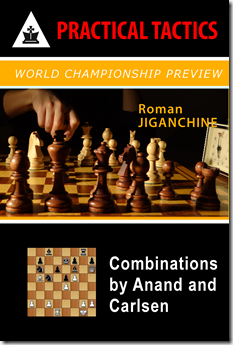
Chess World Championship Preview - Deja Vu - Combinations by Anand and Carlsen

The second match between Anand and Carlsen is approaching, and it was almost exactly a year ago that I wrote this post below. If you are wondering why these two players are still the best in the world, studying their combinations may give the answers!

 Chess World Championship Preview - Combinations by Anand and Carlsen:
The World Championship match between Magnus Carlsen and Viswanathan Anand has been anticipated throughout the chess world since Carlsen qualified from the London Candidates tournament, and there has been no shortage of forecasts. Rather than try to predict the winner, I released a new ebook that gives a preview of the match by showing the best combinations of each player - collected throughout their entire careers. You get a chance to play like the current world champion, or like the future one, if the title changes hands in the 2013 match.
Over 130 annotated test positions will help you better appreciate the enormous tactical strength of both players, while also serving as a tribute to the careers of both players.
You can get the book from Amazon here: World Championship Preview - Combinations by Anand and Carlsen 
image.

Thursday, October 16, 2014

Best Combinations - September 2014 (Monthly Chess Tactics Book 9)

The September edition of the Monthly Tactics series is out with over 100 puzzles for you to solve, available in Amazon and Kobo stores.


Book description:
This publication is a collection of over 100 best combinations played by strong chess players in tournaments that took place in September 2014. To see the solution for the combination - go to the next page in your e-reader. The book is the ninth in the "Monthly Chess Tactics" series, which provides regular updates with instructive tactical positions from the most recent top chess tournaments. The first eight instalments covered January to August of 2014.

The major tournaments of September 2014 were happening in Bilbao, Spain. The European team championship was won by SOCAR club from Azerbaijan in the open event, and Georgian club Nona in the female section. Anand won the Bilbao Masters chess tournament, held at the same time and location, ahead of Aronian. The October edition will cover the first stage of the next World Championship which will begin with the Grand Prix tournament in Baku, with the world's strongest grandmasters participating.

About the series:

“Monthly Chess Tactics” will allow you to

  • Catch up on latest major chess news
  • Follow top grandmasters
  • Improve your game
  • Study combinations any time and anywhere
  • Enjoy a collection of annotated puzzles that you have not seen in any other tactics books
  • Maintain regular practice by solving several puzzles every day

Monday, June 2, 2014

Chess News - Russian GM Alexander Morozevich wins XV Poikovsky Karpov Chess Tournament 2014

As reported by ChessBlog, Russian GM Alexander Morozevich wins XV Poikovsky Karpov Chess Tournament 2014:.

Having recently published two collections of Morozevich's combinations, I am glad to see that the former world's #2 player is in top form again. To recap, in the Practical Tactics Series: Attack with Alexander Morozevich - Selected Games and Best Combinations - includes Morozevich's combinations as White, while “Counterattack with Alexander Morozevich” focuses on his games as Black.
cover

Tuesday, December 31, 2013

Video Guide to the Spanish Opening – Repertoire for White

I have made quite a few videos about the Spanish Opening, and wrote an eBook “Spanish Opening - Strategy and Tactics” about it that will give you a brief introduction to the Spanish from the White perspective. To give an overall map/overview to the various variations and to show how my videos fit together, I created this guide with diagrams and links to my videos. Now you can quickly find the video for the variation that you are interested in!

Spanish Opening - Overview
1. e4 e5 2. Nf3 Nc6 3. Bb5

This move characterizes the Spanish Opening.

3. ... a6 4. Ba4 Nf6 5. O-O

243 Black's first big decision is on move 5, he can choose between the classical lines, and the two sharp alternatives - the Moeller Variation, and the Open Variation.

5. ... Be7

( 5. ... Nxe4 This is the Open variation where Black accepts the challenge and takes the unprotected pawn. 6. d4 b5 7. Bb3 d5 8. dxe5 Be6
244 In the Open Variation Black also obtains active piece placement, but here he pays for it with pawn weaknesses. Regardless of whether the game opens up, or the pawn structure becomes fixed - Black will have some difficulties equalizing, as both sample games illustrate: 9. Nbd2 Nc5 10. c3 d4
( It is a common mistake to exchange the white bishop too soon, as the following game illustrates: 10. ... Nxb3?! 11. Nxb3 Be7 12. Nfd4! Nxd4 13. cxd4 O-O 14. Be3 Rc8 15. Rc1 c6 16. Nc5 Bxc5 17. Rxc5 a5 18. Qc2 Bd7 19. f4 f5 20. Rf3 Qe7 21. Bd2 a4 22. Bb4 and White exerted strong pressure in Jiganchine,R-Trotchanovich,P/ Keres 2007, 1-0 )
11. Bxe6 Nxe6 12. cxd4 Ncxd4 13. a4! Be7 14. Nxd4 Nxd4 15. Ne4 Ne6 16. Be3 O-O 17. f4 and White won in Karpov,A-Korchnoi,V/Merano 1981 )
( 5. ... b5 6. Bb3 Bc5
 245
This is the Moeller - Black develops the bishop to an active position, where it can become a target. The bishop will also be missing on the d8-h4 diagonal, so White's tries for advantage involve Bg5, as the sample game shows: 7. a4 Rb8 8. axb5 axb5 9. c3 d6 10. d4 Bb6 11. h3 O-O 12. Re1 Bb7 13. Na3 exd4 14. cxd4 Na5 15. Bc2 b4 16. Nb1 c5 17. Bg5 h6 18. Bh4 b3 19. Bxb3 g5 20. Nxg5 hxg5 21. Bxg5 and White had a strong attack in Hracek,Z-Shirov,A/Germany 1997, 1-0 )

6. Re1 b5 7. Bb3 d6 8. c3 O-O 9. h3 Na5

( 9. ... Bb7 10. d4 Re8 11. Nbd2 Bf8 246 This is the Zaitsev variation where Black puts a lot of pressure on the 'e4' pawn; against this I recommend shutting down the center on move 12 with d4-d5. When Black undermines it by c7-c6 - White plays for occupying the d5 square, or tries to use the power of his bishop on the a2-g8 diagonal. 12. d5 Nb8 13. Nf1 Nbd7 14. N3h2 Nc5 (Allowing the white bishop to remain on b3 is rather dangerous: 14. ... c6 15. dxc6 Bxc6 16. Bg5 Qc7 17. Qf3 Qb7 18. Ng3 d5 19. Ng4 dxe4 20. Qf5 with attack in Kovacevic, A-Gligoric,S/Niksic 1997, 1-0 )
15. Bc2 c6 16. b4 Ncd7 17. dxc6 Bxc6 and White started to fight for the 'd5' square in Anand,V-Kasimdzhanov,R/Mainz 2007, 1-0 )

10. Bc2 c5 11. d4 Qc7 12. Nbd2

247 Black is at the crossroads.

12. ... Nc6

( 12. ... cxd4 is the main line, immediately initiating play along the 'c' file. 12...Bd7 is the most popular alternative. 13. cxd4 Bb7 14. d5 Rac8 15. Bd3 Nd7 16. Nf1 Nc5 17. Ng3 Nxd3 18. Qxd3 Qc2? 19. Qxc2 Rxc2 20. Nf5 Re8 21. b3 Bc8 22. Nxe7+ Rxe7 23. Be3 Nb7 24. Bb6 Re8 25. Rec1 Re2 26. Rc7 248 and White won due to his domination on the 'c' file in Aseev,K-Sturua,Z/Lvov 1985, 1-0)
( 12. ... Bd7 Temporarily maintains tension in the center. 13. Nf1 Rfe8
( 13. ... cxd4 14. cxd4 Rac8 15. Ne3 Nc6 16. d5 Nb4 17. Bb1 a5 18. a3 Na6 19. b4 g6 20. Bd2 axb4 21. axb4 Qb7 22. Bd3 Nc7 23. Nc2 Nh5 24. Be3 Ra8 25. Qd2 1-0 Tal,M-Hjartarson,J/ Reykjavik 1987, 1-0 )
14. Ne3 g6 15. dxe5 dxe5 16. Nh2 Rad8 17. Qf3 Be6 18. Nhg4 Nxg4 19. hxg4 Qc6 20. g5 Nc4 21. Ng4 Bxg4 22. Qxg4 f6?! 23. gxf6 Bxf6 24. a4 +/- Fischer - Unzicker, 1959, 1-0 )

13. d5 Nd8 14. a4 Rb8

249

15. axb5

( 15. b4 is Geller's interpretation of this line: previously White would first exchange on b5, but that would give Black a better chance of fighting for the 'a' file. 15. ... c4 16. Nf1 Ne8 17. axb5 axb5 18. N3h2 +=
( 18. Ng3 g6 19. Nh2 Ng7 20. Rf1 Bd7?! 21. f4 Bh4 22. Qf3 f5 23. fxe5 dxe5 24. exf5 Bxg3 25. Qxg3 Nxf5 26. Qf2 Nb7 27. Ng4 h5 28. Ra6! hxg4 29. Rxg6+ Ng7 30. Rxg7+ and Black was mated in Nunn,J-Short,N/Brussels 1986, 1-0 )
18. ... f5? 19. exf5 Bxf5 20. Bxf5 Rxf5 21. Be3 Rf8 22. Nf3 +/- Geller,E-Smyslov,V/Palma de Mallorca, 1970, 1-0 )

15. ... axb5 16. b4 Nb7 17. Nf1 Bd7 18. Be3 Ra8 19. Qd2 Rfc8 20. Bd3 g6 21. Ng3 Bf8 22. Ra2 c4 23. Bb1 Qd8 24. Ba7 Ne8 25. Bc2 Nc7 26. Rea1 Qe7 27. Bb1 Be8 28. Ne2 Nd8 29. Nh2 Bg7 30. f4 f6 31. f5 g5 32. Bc2 Bf7 33. Ng3 Nb7 34. Bd1 h6 35. Bh5

250 with a dominating position for White in Karpov,A-Unzicker,W, Nice 1974

1-0

Saturday, December 21, 2013

Attack With Alexander Morozevich - eBook Sequel

I have just published my latest book in the Practical Tactics Series: Attack with Alexander Morozevich - Selected Games and Best Combinations. The format is similar to “Counterattack with Alexander Morozevich”, but the second book focuses on his games with the White pieces and has more examples and some of the games are annotated in more details.

cover 

Video preview of my earlier book about Morozevich:


Wednesday, December 11, 2013

Chess Strategy and Tactics: Ebook about rook and knight endgames

I added a new ebook to my list of my publications, this one is called "Rook and Knight Endgames - Strategy and Tactics".

This ebook is a follow up to my ebook about endings with each side having a rook and a bishop of opposite color - Bishop endgames - Do the opposites Attract?. The idea behind these series is the approach that Nimzowitsch used to call "a radioactive method" - selecting a rather narrow topic, and by learning a lot about it, understand chess much better in general. This time I would like to look at endings with rook + knight Vs. rook + knight. This material balance is also a quite frequent guest in tournaments, and some classical ideas and endgames have become well-known. Nonetheless, there is some lack of discussion of this topic in chess literature. Mikhail Botvinnik was well known for his great technique in this type of endings, and I would strongly recommend to the reader to study two famous endgames Botvinnik-Alekhine 1938, and Botvinnik-Levenfish, 1937. Instead of these, I included several less known examples from his career. Also games by other famous players such as Korchnoi, Morozevich and Anand are featured.

cover Sample game video:

Saturday, November 2, 2013

Chess World Championship Preview - Combinations by Anand and Carlsen

The World Championship match between Magnus Carlsen and Viswanathan Anand has been anticipated throughout the chess world since Carlsen qualified from the London Candidates tournament, and there has been no shortage of forecasts. Rather than try to predict the winner, I released a new ebook that gives a preview of the match by showing the best combinations of each player - collected throughout their entire careers. You get a chance to play like the current world champion, or like the future one, if the title changes hands in the 2013 match.

Over 130 annotated test positions will help you better appreciate the enormous tactical strength of both players, while also serving as a tribute to the careers of both players. This is my 6th book on Amazon; other books are described in my older post From Blogging to Ebooks.

You can get the book from Amazon here: World Championship Preview - Combinations by Anand and Carlsen 

image

Here are a couple of sample puzzles/combinations from the book (Hint – there is a similarity between the two puzzles as the same piece is being sacrificed.

Anand, Viswanathan - Kasparov, Garry 1991 , B82

1. e4 c5 2. Nf3 d6 3. d4 cxd4 4. Nxd4 Nf6 5. Nc3 a6 6. f4 e6 7. Bd3 Nbd7 8. O-O Qb6 9. Be3 Qxb2 10. Ndb5 axb5 11. Nxb5 Ra5 12. Rb1 Rxb5 13. Rxb2 Rxb2 14. Qa1 Rb6 15. Bxb6 Nxb6 16. Qc3 Be7 17. Rb1 Nfd7 18. Qxg7 Bf6 19. Qh6 Ke7 20. Bb5 Rg8 21. Rd1 e5 22. f5 Nc5

30 White to move. See the solution and full game here.

Carlsen, Magnus - Andriasian, Zaven  2003 , D17

1. d4 d5 2. c4 c6 3. Nf3 Nf6 4. Nc3 dxc4 5. a4 Bf5 6. Nh4 e6 7. Nxf5 exf5 8. e3 Bd6 9. Bxc4 O-O 10. Qf3 g6 11. h3 h5 12. Bd2 Nbd7 13. O-O-O a6 14. g4 fxg4 15. hxg4 hxg4 16. Qg2 b5 17. Ba2 c5 18. Ne4 Qe7 19. Nxd6 Qxd6 20. dxc5 Qe7 21. Bc3 Rac8 22. Rxd7 Qxc5 23. Kb1 b4

125 White to move See the solution and the full game here

Tuesday, October 8, 2013

From Blogging to Ebooks

You may have noticed a certain lack of updates on this blog in the past year or so. This has been mostly related to my attention being focused to writing chess Ebooks.

Today I would like to overview what I had published in the past year. While blogging is a simple way of sharing chess knowledge, it is less appropriate for explaining a topic in more details. This is where ebooks come in.  My books so far have been focused on three main themes - endgames, tactics and opening/middlegame. I plan to continue expanding on these themes further.

Tactics
It is essential for every chess player to be continuously working on their tactics, so I wrote a couple of books that allow readers to easily practice their skills on the Kindle, or on any IOS or Android Mobile device.
Openings
Every game has an opening stage, and it's important to be prepared for anything an opponent can surprise you with, and also to have a few ideas of your own.
Both opening books contain a large number of puzzles, to reinforce the ideas of each opening.

Endgames
In my opinion, it makes sense to cover endgames based on material, and from learning one material balance it is possible to understand endgames deeper in general.
The book also has a lot of endgame puzzles to solve.

I would be very glad to hear your feedback and suggestions for future books!

Hit Counter