An unexamined life is not worth living.

Showing posts with label annotated game. Show all posts

Sunday, May 30, 2010

Keres Memorial 2010 games - with Videos

Keres Memorial 2010 was held last weekend in Richmond, British Columbia. While last year I wrote up a summary with diagrams, this time I instead captured fresh impressions of my games into several Youtube videos:

Round 2 game - A complex middlegame in the Sicilian Dragon, with Black throwing multiple sacrifices at my position to keep his initiative going. This turns out to be an effective strategy in time trouble! Part 2 shows how the game concluded.
 

Round 3 game - White sacrificed the d4 pawn in the well known variation of the French Defence. In return he gets faster development, and soon - the material advantage. A fairly simple and somewhat instructive game (I say “simple”, but of course just like any game - took a lot of effort over the board).
 

The last round game where both players needed to win. Black's king was a bit more exposed and that allowed me to create an unexpected attack. Black overlooked a very unexpected defensive resource and soon had to resign because his queenside collapsed, and dark squares around his king were catastrophically weak.

PS. My Youtube channel now has 40 chess-related videos, feel free to watch more clips and subscribe :-)

Tuesday, November 17, 2009

Opposite Coloured Bishops – part 10

I am continuing the series of annotated games with endgames with bishops of opposite colours. More examples are here.
(12) Suetin Alexey S (RUS) - Botvinnik Mikhail (RUS)
Ch URS Moscow (Russia), 1952

opposite_bishop_120

45...Bxe4 ?! with two bishops and an extra pawn Black is clearly winning; now things become more complicated. After being removed from the USSR Olympic team in 1952 ''for poor results", the WC, Mikhail Botvinnik was anxious to win the 1952 USSR Championship, to prove that "he could still play chess". In the final round he needed a win to catch up with Mark Taimanov; as a result, this endgame becomes the struggle of nerves. [45...Rf3-/+] 46.Bxe4 d5 47.Bd3 Be5 ? ! [47...e5 Botvinnik recommends: 48.Rb6 e4 49.Rxb7+ Kd6 50.Bxa6 Rxc2 -1.22 in positions with rooks + bishops of opposite colours, it is important to have a strong pawn center that would reduce the scope of opponent's pieces, bishop in particular (note a similar idea in Alexander-Smyslov) . Even though the material gets reduced, White's pieces are disorganized. 51.b4 ?! For example: (51.Rb6+ !? seems to be better) 51...e3 52.Kb3 ? ! (52.a5 Rc4 ! 53.Rb6+ Ke7 54.Bxc4 dxc4 55.Rb7+ Kf6 -5.50) 52...e2 !] 48.Rg8 Kd7 49.b4 Bf6 50.Rg1 Diagram

opposite_bishop_121

50...Rh2 again, Botvinnik notes that the 'e5' pawn must be pushed as soon as possible [50...e5 !] 51.Kb3 Kd6 52.Rd1 Ke7 53.c4 Rb2+ 54.Ka3 dxc4 55.Bxc4 Rc2 56.Bb3 Bb2+ 57.Ka2 Rf2 58.Bc4 a5 59.bxa5 Bc3+ 60.Kb3 Bxa5 61.Bb5 b6 Diagram

opposite_bishop_122

now the position has simplified too much, and most spectators expected a draw to be the result 62.Kc4 Kf6 63.Kd4 Rf4+ 64.Ke3 Ke5 65.Rh1 Re4+ 66.Kd3 Rg4 67.Rh5+ Kd6 68.Rh8 Ke5 69.Rh5+ Kf4 70.Rh3 Rg8 71.Rh4+ Ke5 72.Rh5+ Kd6 73.Rh4 Rg3+ 74.Ke4 [74.Kd4 ! 0.00] 74...Bd2 Diagram

opposite_bishop_123

75.Bd3 ? now a small miracle happens. 75...Bg5 ! 76.Rh5 Kc5 Diagram

opposite_bishop_124

White has to give up material to avoid mate. Probably inspired by such a finish, Botvinnik went to on to win his 7th national title in the tie-break match against Taimanov. 0-1

Replay game in the viewer:

Sunday, November 15, 2009

Opposite Coloured bishops – Part 9

Aron Kapstan recently won 2009 Manitoba Seniors Championship. Here is a game of his that I annotated for one of my older articles. He nicely outplayed a less experienced opponent in the complicated endgame.
(11) Tootoosis Harvey - Kaptsan Aron
CAN-op (2), 09.07.2000

opposite_bishop_114

37...Bxc3 38.b3 e6 39.Bc4 White is up two pawns and should win. 39...Kg7 40.Kc2 Bb4 41.Rd7 Kf6 Diagram

opposite_bishop_115

42.f5 ?! This 'tactical' shot just helps Black. 42...exf5 43.Rxf7+ Ke5 44.Kd3 ? [44.Bd3+-] 44...Rh8 Now the position becomes unclear. Black gets his own passer, which is supported by the king, rook, and bishop. To stop this pawn White sends his king. Seems to be a bit risky, does not it? 45.Rb7 Rxh3+ 46.Ke2 Bc3 Diagram

opposite_bishop_116

47.a5 !? White keeps finding tactical resources... 47...Ke4 [47...Bxa5 48.Rb5+] 48.a6 Rh2+ 49.Kf1 Diagram

opposite_bishop_117

49...f4 ? I think that Black is playing just using his intuition in this entire endgame. [49...Kf3 !? More precise was 50.Bd5+ Kg3 51.Rb8 (51.a7 ? 51...Rf2+ 52.Kg1 Rf4 -5.50) 51...Rf2+ 52.Kg1 Bd4 53.Rg8+ Kh3 and Black seems to be getting a draw: 54.Bc4 Rg2+ 55.Kf1 Rxg8 56.Bxg8 Kg3 57.Ke2 Kf4 0.00] 50.Rd7 f3 Diagram

opposite_bishop_118

51.a7 ?? Missing something very important... [51.Bd5+ White had some winning chances after 51...Ke3 52.Re7+ Kd3 53.Bxf3 Bd4 54.Be4+ (54.a7 ? 54...Rf2+ 55.Ke1 Rxf3-/+ !) 54...Kc3 55.Bd5 Ra2 56.Rc7+] 51...Rh1+ 52.Kf2 Be1# Diagram

opposite_bishop_119 0-1

Wednesday, May 20, 2009

Paul Keres Memorial 2009 - overview

Jack Yoos had a great tournament this year, only a month after moving to Vancouver from Montreal. Welcome back, Jack!

Just like I gave an overview of my BC Closed games last October, here are some little notes with quick impressions of my play.

Round 1: LeBlanc – Jiganchine (0-1)

image Black to move.

White is a bit better: 16… Rxd6 is not good due to 17. c5 and the knight on d6 is strong.. Since my bishop is also attacked, I decided to move it with a gain of tempo, playing 16… Bg4. White responded with a big blunder – 17.f3??. After Qxd4+, black picks up up two pawns, so the game ended pretty quickly: 17… Qxd4+ 18. Kh1 Bxf3 19. Rad1 Qxd1 20. Qxd1 Bxd1 21. Rxd1 Ne8 0-1

This surely reminded me of my game against Paul from last year’s Keres where after my blunder he had a winning position, but blundered back and lost.

Round 2: Jiganchine – Orlov (1-0)

If you live in BC, Canada then - basically Georgi Orlov is the strongest player you get to regularly see. And after playing in Keres Memorial 6 times – I never actually got to play him – until the 7th tournament. Jack Yoos and Sergei Sokourinski used to have an argument about whether Orlov and Spraggett were of similar strength, and while Jack was convinced (based on his own score against each) that Spraggett is stronger, the very fact of comparison being made speaks volumes.

Black risked a bit more than he should have in the opening, and the ‘star’ move definitely came here, after Black played … c5.

image White to move

19. Bc6!

No, this is not me drawing the arrow on the diagram incorrectly - the bishop actually did stop one square short from taking the rook. The rook is not running away (taking it would give Black compensation), instead White totally dominates central squares and increases pressure against c5 pawn with Qd5 coming. After the game Georgi admitted having missed this move. He then had to give a rook for a dark squared bishop, and my light squared bishop live to tell the tale, the game ended after some complications in this position:

image White to move

38. Rbf7! and Black resigned since Bf3 mate can’t be prevented without giving up the queen.

After this game – the tournament kind of ended for me – I took a bye, and then still could not play normally since the feeling of having done something special overwhelmed me. This was the first time I played an International Master in my entire life, so to score a win from the first attempt felt quite extraordinary. I realized that Georgi was rusty, and that he comes to Keres Memorial to play risky chess against local amateurs like myself which does mean he loses a game like this once every couple of years, but I still could to get back to my senses (I did try quite hard).

Round 3:  bye (1/2) I was quite exhausted after the previous game, and having been tired before the tournament (this programmer’s been very busy at work recently) – I had planned to take a bye anyway, so this seemed like a good moment for that.

Round 4: Jiganchine – Gentes (1/2-1/2)

image 24… Qb6

After some manoeuvring by both sides, in this position Kevin offered me a draw, which I accepted. During previous few moves I was mostly focused on keeping positional balance.

Round 5: Pechisker – Jiganchine (1/2 – 1/2)

This was the game that really threw me off balance and probably had to do with my dismal play the next day. Alfred has a style that I find hard to adjust to, so every game against him is usually hard for me. Just like in our last game in the BC Closed, I got a great position out of the opening (Slav defence), but failed to convert.

image Black to move

23… Bd5! White has to give up a pawn with 24. e4 just to rescue his tied up pieces.

However a few moves later, the game was somewhere between winning for Black, and a draw and I made a humongous error:
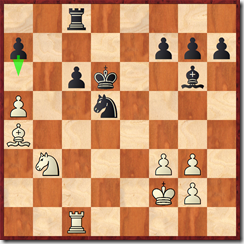
image 35… a6? allowed 36. Nc5, and suddenly my pawns are weak, pieces are passive, and I am low on time.

That kind of move is hard to explain, but I think, I had planned c6-c5, and was concerned about a5-a6, and Nb3-a5-b7 with counter play. Fortunately this time my desperate measures worked, and in the complications Alfred offered a draw, which I accepted. I was terrified however that I allowed such massive counter play in a technical position.

Round 6: Jiganchine - ChangeHe Li (1/2 – 1/2)
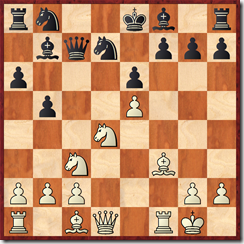
image White to move

Another Sicilian Scheveningen, just like in round 4, and again my understanding of position was lacking.
In my quick preparation the morning before the game I had anticipated something similar (an early e4-e5 break), but did not look deep enough.
Here apparently 12.Bxb7 Qxb7 13.Qh5! scores around 90%. I instead played 12. Bf4 and after 12…Nc6 took the knight and offered a draw. I was uncomfortable playing a young improving player, but also getting increasingly worried that I misplayed something (which was kind of true). I also wanted to get some rest before the final round (but had I known that after a draw I would get to play Jack, I would have re-considered).

Round 7: Yoos – Jiganchine (1–0)

I had not lost to Jack Yoos since 1999, but I still remembered the feeling of getting blown off the board before the opening was over. I really wanted to avoid that, so instead of my main opening as Black – I played the line in the Caro-Kann, which I believed to be passive but solid.
Jack played very energetically and still had a very dangerous initiative:

image Black to move

Being tired from defending for the last couple of hours - I missed the most obvious threat created by 19.Nc2 – which is Bxc4, and knight has to keep guarding d7, so White gets his pawn back with great position. Trying to get Nh6 into the game - I played 19…f7-f6? (instead Rd8 was better) and after 20.exf6 gxf6 21.Bxc4! and Rhe1 – I made a few more blunders and lost fairly soon (but things were really going downhill at that point). I was very impressed by the way Jack treated this opening variation (and wished I had put up a better resistance).

Wednesday, September 10, 2008

Fullbrook - Milicevic, BC Closed 2001

Replay Game Nigel Fullbrook - Dragoljub Milicevic, BC Closed 2001

Nigel Fullbrook - Dragoljub Milicevic

BC Closed/Vancouver (9.4) 2001


40. Kd2 Black's advantage (space + 2 bishops) is obvious and yet it is not quite clear how to exploit it. 40... Ng4! A beautiful strategic piece sacrifice! 41. fxg4 forced 41... hxg4 42. Rh1 g3


43. Nd3 Bg4 It is interesting that even Fritz immediately evaluates this position in Black's favour 44. Ne1 f4-f3 was a threat 44... Rh5 g5 is threatened and it is not clear how White can untie his pieces 45. Nb2? Be3# By winning this game Dragoljub Milicevic also won the title, his 3rd in the last 5 years. However, in 1997 and in 2000 he had to share it with M. Fuentebella and J. Berry. This is his first clear victory. Congratulations! 0-1 [Roman Jiganchine]

Hit Counter