I usually do not post very detailed analysis on this blog since
a) complicated analysis is not always necessary to illustrate an idea
b) who has time to read chess complex analysis on the Internet
c) lengthy variations often contain errors and are wrong anyway
In this pawn endgame from one of my games from 2000 BC Active Championship – complex analysis is required, but ideally the result of such an analysis is not a myriad of variations, but rather a collection of themes and ideas that serve the purpose of finding the truth – evaluation of each given position that occurred during the game. I suggest that you look at the ideas first, and only if you`re interested – look at the more detailed analysis.
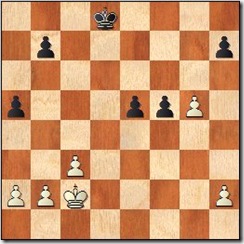 Black to move, initial position
Who is better here? During the game, I felt that White ought to be better (even winning) because White would create two disconnected passed pawns – one on the kingside, and one on the queenside. Black king would not be able to stop both, while White king can safely block the ‘e’ and ‘f’ pawns. Things are a LOT more complicated however, because Black has several counterattacking ideas:
1) Black can have pawn breakthrough on the queenside to create his own passed pawn, before White gets his ‘h’ pawn going.
Imagine after 34...e4! 35.Kd2 f4 36.a4 Kd7 37.b4 Creating a passed pawn like this does not work since central pawns are too far advanced, and g and h pawns are not going anywhere, so Black king can stop the a pawn
 Black to move - 37...b5!! –+ This idea reminded me of the game Adams – Lutz from Endgame Secrets by Lutz.
2) Black can activate the king to support central pawns
Again, imagine a hypothetical position after 34. Kd7 35. a4 e4 36. b4 axb4 37. cxb4 f4 38. h4 Ke639. a5 Kf5 40. b5 f3 41. Kd2
 Black to move 41… Kg4!! 42. a6 f2 43. Ke2 Kg3 44. axb7 Kg2 45. b8=Q f1=Q+ 46. Kd2 Qd3+ 47. Kc1 e3 –+
But not 41... Kf4? 42. a6 f2 43. axb7 f1=Q 44. b8=Q+ with a draw since White queens with check. Mark Dvoretsky's Endgame Manual has several similar positions. I remembered from his book that it is advantageous to have the pawns advanced as far as possible – in that case when the king supports the pawns, they are a lot more dangerous. For the same reason, it is better for White to play Kd3, sooner rather than later. Already here we can see that in this endgame – every tempo may count.
3) Black can blockade White pawns if they are advanced carelessly - This is what happened in the game, after 34… Kd7 35. b4? axb4 36. cxb4 b5!
 Now White will actually have to sacrifice a pawn with a4 to have any chances for counter play.
If Black is careless (and in our game he was), however, that breakthrough will be very effective:
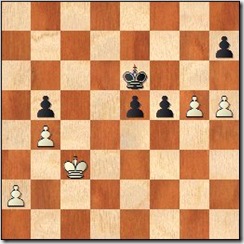 White to move 40.a4! bxa4 41.g6! hxg6 42.h6 Kf7 43.b5 f4 44.h7 Kg7 45.b6 f3 46.b7 f2 Diagram
 White to move 47.h8Q+ every tempo counts! Kxh8 48.b8Q+ +-
Now that I covered the themes of this endgame, and assuming you are still bearing with me, on to what actually happened in the game, which turned into a comedy of errors, as we were blasting off the last moves in SD time control.
Jiganchine,Roman - Remedios,Russell [B76] BC Active (2), 17.06.2000

34...Kd7?
it may be hard to evaluate this move precisely, but likely committing the king too early was a mistake. The core of the position seems to be that Black needs to advance his e and f pawns ASAP, and White should create passed pawns on kingside and queenside. The White pawns have not advanced far enough though, and Black manages to create his own queenside passer in many lines 34...e4! was correct, I believe Black is winning –+
35.b4? Now only black can play for a win. Correct was 35. Kd3! Ke6 (35...e4+ !?) 36.h4 on the kingside - White can create a passed pawn (or a threat of one), on the queenside - both sides can create a passed pawn if white plays a4 and b4, and Black breaks through with b5. So maybe makes sense to advance kingside pawns first? 36...Kf7 37.h5 Ke7 38.a4+- Diagram

White is winning since Black does not have time to bring central pawns into motion 38...f4 39.Ke4 Ke6 40.b4 f3 41.Kxf3 Kf5 42.bxa5 Kxg5 43.c4 Kxh5 44.c5 Kh4 45.a6+] 35...axb4 36.cxb4 b5 Diagram

during the game - here I realized that I made a mistake. the tables have turned, now White will have to create rescuing chances by the a4 break, but his king will have to guard the e and f pawns as well 37.h4 Ke6 Diagram

38.Kc3? 38.Kd3! definitely makes more sense, even though it could still be losing
38...Kd5??+- Diagram

Without good reason - the king goes too far away from the h pawn [38...f4 Diagram

and White king is too far from e4 39.h5 Kf5 40.g6 hxg6 41.h6 Kf6-+ 42.a4 f3 43.Kd3 bxa4 44.b5 f2!-+ Diagram
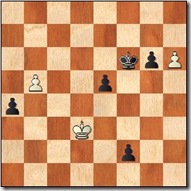
this is why it is better to have White king closer to the ‘f’ pawn before playing a4 45.Ke2 a3 46.h7 Kg7 47.h8Q+ Kxh8 48.b6 a2 49.b7 f1Q+ 50.Kxf1 a1Q+-+]
39.Kd3??-+ Diagram

this move should have lead to a loss.
[39.h5! was correct Ke6 Diagram
 40.a4! bxa4 41.g6! hxg6 42.h6 Kf7 43.b5 f4 44.h7 Kg7 45.b6 f3 46.b7 f2 Diagram
 47.h8Q+ Kxh8 48.b8Q+;
After 39.Kd3? Now black gives a few decisive checks, and the breakthrough is no longer possible, since Black's `a` pawn runs ahead, and my king is too far to stop it. 39...e4+ Black gains decisive tempo for advancing his pawns. 40.Kd2 f4 41.h5 Ke6 42.g6 hxg6 43.h6 Kf6 44.a4 bxa4 45.b5 a3 46.h7 Kg7 47.b6 Kxh7 48.b7 a2 49.b8Q a1Q 50.Qxf4 Qa5+-+]
All this did not matter, since we were both so short on time and confused about what was going on that we agreed to a draw: 1/2-1/2
A very complicated pawn endgame, in which both White and Black were taking turns in making decisive mistakes. The endgame was initially winning for Black, then tables turned several times, some variations lead to possible draw in queen endgames. When I looked at it the first time in 2007, I came to several wrong conclusions, and even now, after spending another few days on it – I am not sure of all evaluations! Pawn endgames are supposed to be simple …
You can replay it in the viewer with even more detailed analysis:




 Posts
Posts

